Posts

Oxnead, St. Michaels and All Angels
Image
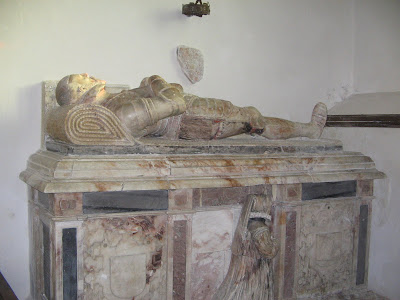
From Buxton Station, on the Bure Valley Path and Railway, I crossed the tracks and walked into open fields. A gentle gradient led over the crest of a hill, where my spirit rose as a skylark provided the appropriate sound track! The path fell away to a wooded valley. Here a bridge over River Bure provided the opportunity to play Pooh Sticks . It’s a good occupation if there are things you need to let go of, believe me! I reflected about some of those things, forgiveness and baptism . There were no doves to be seen, but a chorus of birdsong gave me much to consider! Pensively I took the path that led up-stream, through green pastures and beside still(ish) waters ! Two mares, each with a foal, lifted their heads as I passed by. At the main road I turned right, crossed the bridge, avoided going to the Haflinger Stud and took the next road on the right. After about a quarter of a mile, I turned right again, just before the out-buildings of Oxnead Hall. No sign announced it but, at t...

The people who walked in darkness........

Image
Before central heating, electric lighting, sodium street lights and supermarkets, the harshness of late winter and Lent scarcity was experienced first hand. It was cold and dark. The waxing of the moon and lengthening of days, the growing warmth, Good Friday’s hot-cross buns and Easter’s eggs, were looked for and longed for. In the 21 st century none of us experience these things with the same intensity but they need not be lost to us entirely, especially if we get outdoors a lot. The when of Easter is really important. It was settled for us long ago, in the 7 th century, at the Synod of Whitby. The principle for fixing Easter is simple. It should fall on the first Sunday, after the first full moon that follows the first day of Spring. Its about new beginnings and darkness and light! We do things with candles in church but outside the full moon shines and, for the first time in the year, night’s darkness is shorter than the length of the day’s sun! Reflecting on these ...

Dominus Flevit

Image
The path that leads down the Mount of Olives gave Jesus and his fellow pilgrims a panoramic view of the Jerusalem on Palm Sunday. Overshadowing all, mid-stage, was the great bulk of the Temple . Similar views of Norwich are visible as one walks down from Mousehold Heath. In the midst of the cityscape, the Anglican Cathedral. Above Gethsamane is another olive grove. In spring the green of the grass is punctuated with the brilliant red of anemones, reminders that Jesus sweated blood on this hill! In the corner of the grove is a tear shaped church - Dominus Flevit ! The Latin translates as The Lord Wept . It marks the traditional place where pilgrims to the Holy Land stopped to remember that Jesus had wept over the city and prophesied its destruction. Destroyed and re-built it is a different Jerusalem the modern pilgrim sees today when she stops to pray. In place of the Temple are the Al Asqsa Mosque and the Dome of the Rock. There is tension in the air, and to Jerusalem , th...

Bridgham World Peace Centre

Image
On the edge of the village of Bridgham , where the river Thet winds its way to Fenland Drains, past Lynn and on to the sea and oceans beyond, there is a certain bend. On the bank opposite half mature trees reach for the skies and to get there you walk through a grove of newly planted oaks. At this point the river arrives from the south-east, on the left, and then turns sharply to the south-west, on the right. Here, facing south, so the sun rises on the left and sets on the right, open to the wind, but shaded from the noon heat and protected from the rain that feeds the living river, is a shelter. It looks as if it might have grown out of the dark earth. A bandstand ? A pagoda? A pavilion? It’s called “The Bridgham World Peace Centre”! To which you are invited to come and sit for a while. To: reflect! meditate! ccntemplate! pray! All in the context of the great cycles of the natural world. It is all very Psalm 104! In my experience the effect of just being there ...

Burgh Castle

Image
W here curlews cry , looking west across Breydon Water to the Berney Arms and Windmill and the marshes beyond, stands four-square the walls of Burgh Castle. Here they have stood for over 1600 years! Within these walls a young Irish abbot and his wandering monks built their home sometime around the year 632 AD. The castle was the gift of Sigbert the first Christian King of East Anglia . From here, the faith spread upriver, westwards to the North Folk and along the Waveney Valley . You might say Burgh Castle is one of the cradles of Christian faith! The Fursey Pilgrims ( www.furseypilgrims.co.uk ) came into being to remind people of these, all but forgotten, fathers in Christ. On the first Saturday in October they make an annual pilgrimage to the site. But you could go any time! Canon David Abraham, who led the 2006 pilgrimage tells that, it was a series of visions of the afterlife that so fired the saint that he became an evangelist. “ They profoundly affected his teaching and...

Of Beavers, Skylarks and Cats

Image
The Babingley River has long been tamed, but in days gone past it was treacherous! It was a tidal estuary where, the story goes, St. Felix, the first person to evangelise the East Anglians , was shipwrecked – shipwrecked and then rescued by beavers! Apart from the (now dilapidated) village sign celebrating Felix and the beavers, farm buildings, a ruined 15 th century church and a charming “tin tabernacle” there’s not much left of old Babingley! But there is archaeological evidence of a once bustling settlement around the church. Knowing the way missionaries operated in the early days of Christianity in East Anglia , it is safe to guess that Felix established a monastery and evangelised the whole area from here. There is nothing to see at the church but a well marked permissive path takes today’s pilgrim 2 ½ miles in a circular route around the church, through wide meadows and open skies. The walk begins opposite the place where the B1439 joins the A149. It follows ...

Mannington July

Image
In early July the Rev’d Jane Durell visited Mannington Hall’s boardwalk and bird hide. We arrived as the light was beginning to fail. Coming from noisy Norwich , the great stillness impressed me - just the whisper of the wind in the mature willows surrounding the wet meadow. All the colours were muted and harmonious, almost as if a mist was beginning to rise. We were privileged to see a Barn Owl slowly and silently beating it’s way back into the trees. My friend said it was carrying something - I wondered if it was taking supper home to a hungry nest full? We had passed the sign announcing parking for “the less able”, and ventured down a narrow, grassy and overhung path to find a neat parking place cut in the undergrowth conveniently close to the board walk. From there it was an easy push to get among the marsh flowers and grasses. Hundreds and hundreds of them in all directions – beautiful! Some I knew - others I did not! Red Campion ; and shyly peeping out , Ragged R...

Spixworth in Spring

Image
“Consider, the flowers of the field” says Jesus. As Winter gives way to Spring, it is the flowers of the woodland that lead the way but it’s the same idea! Aconites, snowdrops, primroses, bluebells, orchids…… Snowdrops were being celebrated at St. Peter, Spixworth on Sunday 12th February 2006 with an open day and walks in the churchyard and the surrounding countryside. Unfortunately the heavens were open that day too and February Fill-Dyke lived up to its name! St. Peter’s repeated the exercise on 26th February. On Monday 1st May between 10 a.m. and 5 p.m. it was Bluebell Day at Spixworth. Beginning at the church there were walks of various lengths - ¾, 11/2 or 3 miles - with prayer stations on the way, as children’s environmental activities and refreshments. Jesus’ spiritual practice led him away from the towns and villages. Many of us need to go “apart from the world” too. At bluebell time one of the places worth retreating to is Foxley Wood. It is a true sanctuary, Norfolk’s ...

Considering the Birds

Image
For those who first brought the Christian faith to No rfolk the wild goose was a symbol of the Holy Spirit. The creator spirit that brooded over the face of the waters in the beginning, continues to hatch out things out today! The mighty rushing winds, fiery sunrises and sunsets and hundreds of thousands of over-wintering geese suggest that north Norfolk in winter could be a place of extended Pentecost! At the Royal Society for the Protection of Birds (R.S.P.B) Reserve at Snettisham you may be lucky enough to see thousands of Pink Footed Geese fill the air at dawn and nightfall on their way between roost and feeding grounds. Waiting for the birds can teach much about the dynamics of what it is to watch and pray. Sometimes the birds don’t show for some reason. When they do, how the heart skips! Responding in praise one cannot avoid joining in the hymn of the universe as Creation sings the praise of the Creator. Psalm 148 provides words for the experience – “Wild beasts and all cattle...

Cromer Beach

Image
In some small matters the call for Christians to be Christ-like is easy! Anyone can walk by the seaside! A favourite walk is from Overstrand to Cromer. On a summer’s day, with sunlight dancing on the sea, a breeze blowing your hair everywhere and with the rhythm of the waves on the shore, everything seems alive. A paddle or a swim can intensify a sense of being part of it all and can become an occasion to reflect on baptism. Even on a summer’s day the water can be cold and it’s not all blue skies! Imagine the same beach on a dark and stormy winter’s night. Baptism Service speaks of “the deep waters of death”! Cromer and Cromer men have a proud history of saving life at sea. Henry Blogg, coxen of Cromer boat from 1909 to 1947 is probably the best known lifeboatman ever! He carried out 350 rescues and saved 800 lives. Now the RNLI have done him proud by building the new Henry Blogg Museum at the bottom of the Gangway (opened Spring 2006). It is well worth a visit, if only to enjoy a th...

Praying where the Cows come Holm

Image
On the Horning to Ludham road turn right at the Dog public house and take the back road to Ludham. After half a mile a farm road and bridle path on the right leads, a mile across the marshes, to the ruins of St. Benet’s Abbey at Cow Holm. Tradition has it that the first monastic community was established by Abbot Suneman and a group of hermits in 800 AD on what was then an island used for grazing. Great work has been done to reclaim land for agriculture, but then, before the rivers were embanked, the whole area was tidal marshes and open water where the rivers Bure, Thurne and Ant met. This first monastic community was destroyed by Viking raiders, but in the 10 th century it was re-established by Wolfric and seven companions still following as their predecessors the Celtic pattern of monastic life. Under King Cnut the community was refounded and endowed as a Benedictine house. It was named after St. Benedict ( St. Bene’t’s!) but until the dissolution of the monaste...